

Agentic AI has its own vocabulary, and understanding it matters once you move beyond basic prompt-and-response applications. Terms such as tool calling, MCP, agent memory, orchestration, RAG and human-in-the-loop describe different parts of systems that can decide what to do next, interact with external software and continue working toward a goal.
The easiest way to understand these agentic AI terms is to see how they fit together. An AI agent receives a goal, reasons about the next step, uses available context and tools, observes the result, and continues until the task is complete or a stopping condition is reached. The 20 terms below describe the main pieces of that process.
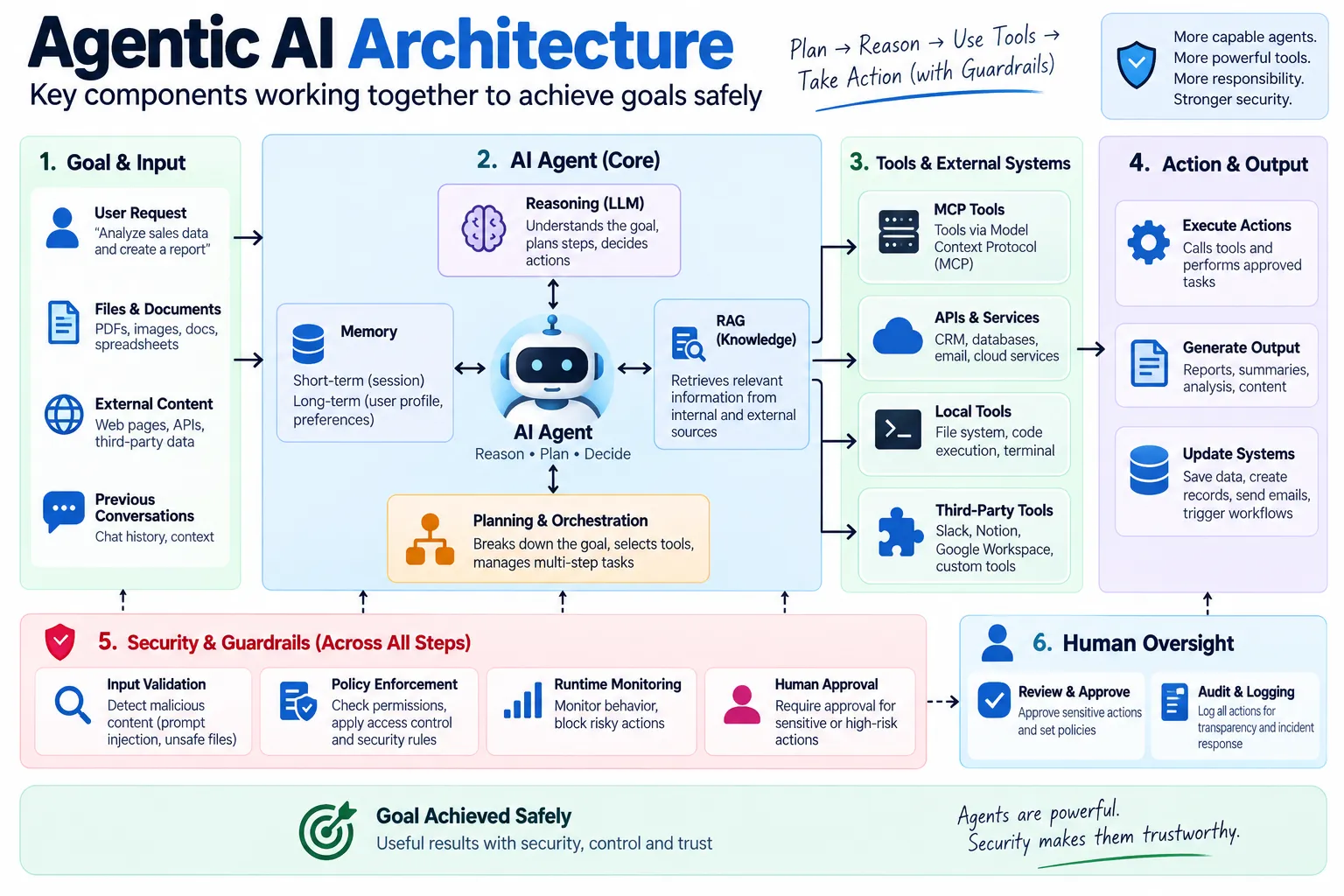
Agentic AI Foundations
Before getting into MCP, memory or multi-agent architecture, four concepts explain what makes an application agentic in the first place.
1. Agentic AI
Agentic AI refers to AI systems designed to pursue goals with some degree of autonomy instead of producing only a single response.
An agentic application may decide which steps are required, choose tools, retrieve information, evaluate results and adapt its next action.
For example, ask a normal chatbot:
"What are the open bugs in this project?"
It might answer using information already in its context.
Give the same objective to an agent with repository and issue-tracker access, and it could search open issues, inspect commits, compare them against source files and produce a prioritized report.
That ability to move through multiple actions toward an objective is what makes the system agentic.
Anthropic makes a useful distinction between workflows and agents. In a workflow, code defines the path in advance. In an agent, the model dynamically determines how to proceed and which tools to use.
2. AI Agent
An AI agent is a software system that uses a model to pursue a goal by making decisions and interacting with an environment.
The environment might include:
- APIs
- databases
- browsers
- local files
- code execution
- search systems
- MCP servers
- other agents
An AI agent is therefore more than the underlying LLM.
A useful simplified architecture is:
User → Agent → Model → Tool → Environment → Result → Agent
The model supplies reasoning and decision-making capabilities, while the surrounding application controls context, tools, permissions, state and execution.
This distinction is one of the most important AI agent terms for developers because saying "the model did it" often hides where an actual system behavior came from.
3. Autonomy
Autonomy describes how much of a task an agent can perform without asking a human what to do at every step.
Autonomy isn't all-or-nothing.
A coding assistant that suggests a command has low autonomy. An agent that edits files, runs tests, examines failures and fixes the code before requesting review has considerably more.
Developers should choose autonomy based on consequences. Reading documentation can usually tolerate more autonomy than deleting production data or issuing refunds.
More autonomy can make an agent useful, but it also increases the need for permissions, stopping conditions, observability and approval controls.
4. Agent Loop
The agent loop is the repeating process an agent uses to make progress toward a goal.
A simplified loop looks like this:
Observe → Reason → Choose Action → Execute → Observe Result → Repeat
Suppose an agent is fixing a failing test. It may inspect the error, open the relevant source file, decide on a change, edit the code, run the test again and inspect the new result.
That cycle continues until the test passes, the agent reaches a stopping condition or it needs human input.
Anthropic describes agents in similar terms: models use tools based on environmental feedback in a loop, gaining new information from tool results or code execution as they work.
Reasoning and Task Execution Terms
Agentic systems become useful when they can decide how to turn an objective into executable steps. That brings us to planning and reasoning.
5. Reasoning
Reasoning is the model's process of working out what information or action is needed to move toward the goal.
For a developer, the important distinction is between reasoning and execution.
An agent may determine that a database query is needed, but the application still controls whether the database tool exists and whether the requested operation is permitted.
You should therefore avoid treating model reasoning as an authorization mechanism.
The model can propose:
Delete customer record 482
A separate policy layer should decide whether that operation can actually run.
6. Planning
Planning is the process of breaking a larger objective into smaller actions and deciding how those actions should be ordered.
For example:
Goal: Investigate why an API became slow.
An agent might plan to:
- inspect recent deployments;
- query application metrics;
- find the slow endpoints;
- inspect related database queries;
- compare the results with previous performance;
- produce likely causes.
Plans don't always need to be generated fully at the beginning. Some agents plan one or several steps, execute them, observe what happened and revise the plan.
That flexibility is useful when the correct next step depends on information that isn't available yet.
Tools and External Actions
An LLM becomes much more useful when it can interact with software outside its model context. Two closely related agentic AI concepts describe this capability.
7. Tool Calling
Tool calling is the ability of a model or agent to request execution of an external capability.
A tool might:
search_web(query)
get_weather(city)
read_file(path)
create_ticket(title, description)
query_database(customer_id)
The model doesn't necessarily execute these operations itself. It produces a structured request, and the agent runtime or application executes the corresponding function.
The result then returns to the agent as new context.
Tools are what turn many agents from text generators into systems capable of taking useful actions.
8. Function Calling
Function calling is a common implementation of tool calling in which the model selects a predefined function and supplies structured arguments.
Suppose you expose:
{
  "name": "get_order",
  "parameters": {
    "order_id": "string"
  }
}
The model might produce a call equivalent to:
get_order(order_id="ORD-1042")Your application validates the arguments, executes the function and returns the result.
The terms "function calling" and "tool calling" are sometimes used interchangeably, but tool calling is the broader concept. A tool could represent a function, API, browser, search service, code executor or another capability.
MCP and Agent Connectivity
One of the most important additions to current agentic AI terminology is the Model Context Protocol.
9. Model Context Protocol (MCP)
The Model Context Protocol, or MCP, is an open protocol for connecting AI applications with external capabilities and context through a standardized interface.
MCP servers can expose primitives such as tools, resources and prompts. Tools allow models to perform actions or retrieve information, while resources provide contextual data.
Instead of building a custom integration pattern for every agent-tool combination, developers can implement compatible MCP clients and servers.
The protocol is also evolving quickly. The July 28, 2026 specification moved MCP to a stateless protocol core, introduced header-based routing, strengthened authorization, formalized extensions and updated the major SDKs.
That makes the protocol version worth checking when reading older MCP tutorials.
10. MCP Server
An MCP server is a program or service that exposes capabilities to an MCP client.
For example, a Git-related MCP server could expose tools such as:
list_repositories
get_issue
create_issue
read_commit
The AI application connects through an MCP client, discovers the permitted capabilities and uses them as needed.
A useful mental model is:
AI Application → MCP Client → MCP Server → Tool / Resource
MCP doesn't automatically make an integration secure. The protocol can expose powerful data-access and execution paths, so permissions, authorization and user control still matter.
For developers building tool-enabled agents, this also makes MCP security part of application security rather than a separate concern. You can read the detailed AI agent security risks and best practices guide for prompt injection, MCP vulnerabilities, permissions and tool-security issues.
Context, Knowledge and Memory
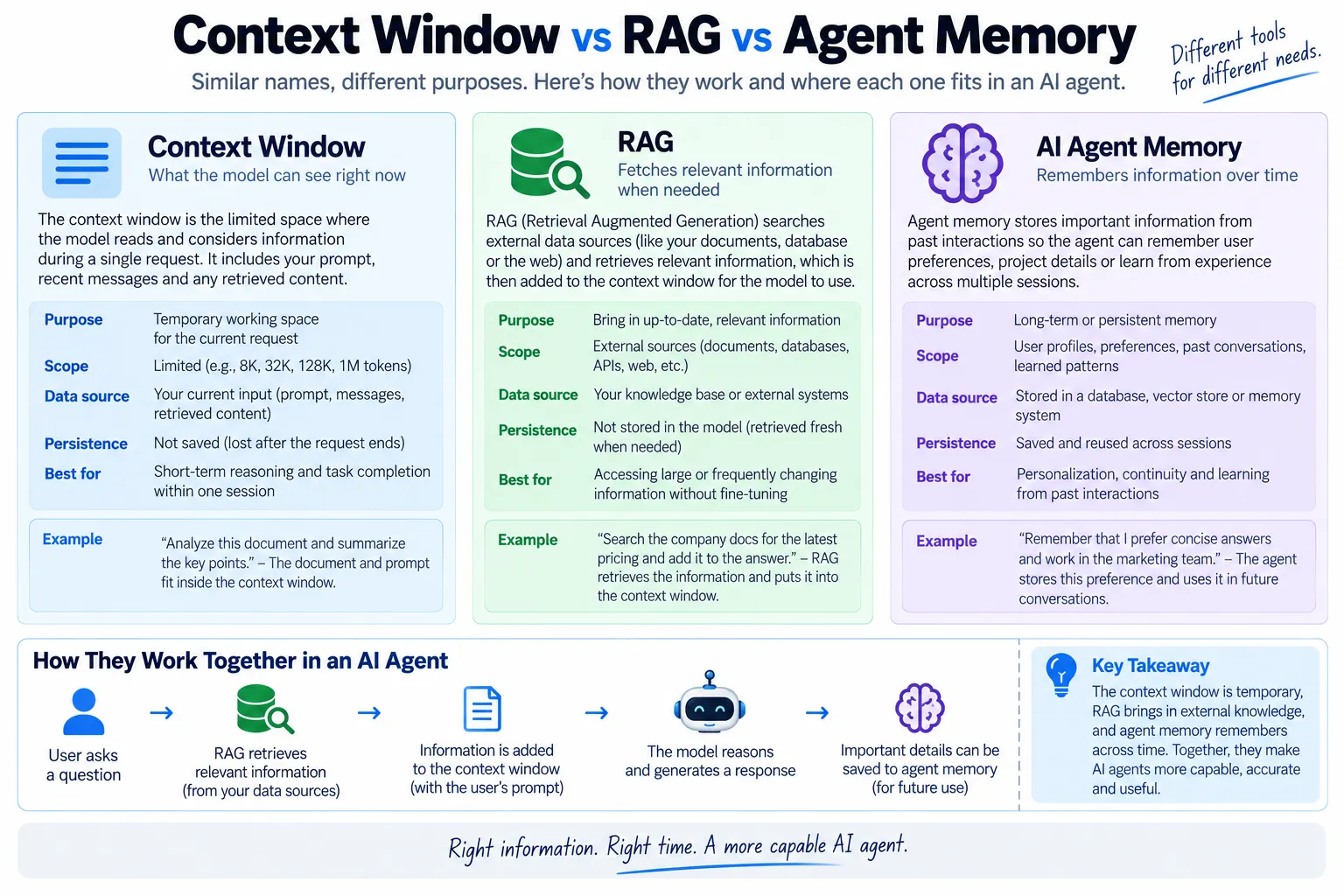
Agents need information from several places. Context windows, RAG and memory solve related problems, but they aren't the same thing.
11. Context Window
A context window is the amount of information a model can consider within a model interaction, usually measured in tokens.
It can contain things such as:
- system instructions;
- conversation history;
- retrieved documents;
- tool definitions;
- tool results;
- application-generated context.
A larger context window can allow more information to be supplied, but "put everything in the prompt" isn't always a good architecture.
Large amounts of irrelevant context can increase cost and make it harder to ensure the model receives the right information. Developers therefore need context management, not simply more context.
12. Retrieval-Augmented Generation (RAG)
Retrieval-Augmented Generation, usually shortened to RAG, retrieves relevant external information and gives it to the model before or during generation.
Imagine an internal support agent answering questions from 50,000 company documents.
Instead of putting every document into every prompt, the application searches for relevant passages and supplies only useful results.
A basic RAG flow looks like:
Question → Retrieve Relevant Data → Add to Context → Model → Answer
RAG primarily helps the agent access knowledge. It doesn't automatically give the agent long-term memory, nor does it guarantee that retrieved content is correct or safe.
13. AI Agent Memory
AI agent memory lets an agent retain useful information beyond the immediate model call.
Memory can include user preferences, completed steps, summaries, task state or information needed across sessions.
For example, a research agent working over several sessions might remember which sources it has already checked.
This differs from the context window. Context is what the model can currently see. Memory is a mechanism for storing information and later bringing selected information back into context.
Short-Term vs. Long-Term Memory
Short-term memory generally supports the current task or session. Long-term memory persists information so it can be reused later.
Persistent Memory Needs Its Own Trust Rules
Developers shouldn't treat everything the model wants to remember as trustworthy.
Persistent memory creates an attack surface because malicious or incorrect information stored today can influence later sessions. OWASP's 2026 agentic-security work specifically discusses memory and context poisoning as a persistent security problem.
Store provenance with important memory, validate sensitive writes and keep authorization policy outside editable natural-language memory.
Multi-Agent Architecture
One agent isn't always the right architecture. Complex systems can split work among specialized agents.
14. Multi-Agent System
A multi-agent system uses multiple AI agents that cooperate, delegate or independently perform different parts of a larger task.
A software-development workflow could contain:
Planner Agent → Coding Agent → Test Agent → Review Agent
Each agent can have different instructions, tools and permissions.
The advantage is specialization. The cost is extra complexity around state, communication, error handling, latency, security and debugging.
Don't use multiple agents merely because the architecture sounds sophisticated. Anthropic recommends increasing agentic complexity only when simpler approaches don't solve the task effectively.
15. Agent Orchestration
Agent orchestration is the logic that coordinates agents, models, tools and workflow steps.
The orchestrator may decide:
- which agent receives a task;
- which context it receives;
- whether tasks run sequentially or in parallel;
- when a retry occurs;
- how results are combined;
- when execution should stop;
- when a human needs to intervene.
Anthropic's orchestrator-worker pattern, for example, uses a central LLM to dynamically break a task into subtasks, delegate them to workers and combine their results.
OpenAI's agent tooling likewise treats orchestration, handoffs, guardrails and tracing as core building blocks for production agent workflows.
16. Handoff
A handoff transfers responsibility for a task or conversation from one agent to another.
Consider a customer-service system:
Triage Agent → Billing Agent
or:
Triage Agent → Technical Support Agent
The first agent identifies the type of request and hands control to a specialist.
Handoffs are different from simply asking another agent for information. In a handoff architecture, control of the workflow can move to the receiving agent. OpenAI's Agents SDK uses handoffs as a first-class orchestration mechanism.
Safety and Human Control
The final four agentic AI terms become increasingly important once agents can change files, call external APIs or affect real users.
17. Human-in-the-Loop (HITL)
Human-in-the-loop, often abbreviated HITL, means requiring human input or approval at selected points in an agent workflow.
It doesn't mean a person has to approve every action.
A useful approach is to reserve approval for actions with meaningful consequences, such as:
- sending a payment;
- deleting production data;
- changing account permissions;
- publishing content;
- executing sensitive administrative actions.
A coding agent might edit files and run tests independently but pause before deploying to production.
The goal is controlled autonomy: automate routine work while keeping humans in the decision path where mistakes would be expensive or difficult to reverse.
18. Guardrails
Guardrails are controls designed to constrain what an agent can accept, produce or do.
They can include input checks, output validation, policy checks, rate limits, tool restrictions and risk-based approval gates.
A key developer lesson is that guardrails shouldn't exist only as instructions inside a prompt.
If an agent isn't allowed to delete production data, enforce that rule in the application or authorization layer as well.
Modern agent tooling increasingly treats guardrails as a distinct runtime component. OpenAI, for example, exposes configurable guardrails alongside tools, handoffs and tracing in its agent stack.
19. Prompt Injection
Prompt injection is an attack or manipulation technique in which untrusted instructions attempt to change how an AI system behaves.
For agents, indirect prompt injection is especially relevant.
An agent might read:
User → Agent → Webpage → Malicious Instruction → Tool
The attacker doesn't need direct access to the system prompt. Malicious instructions may be embedded in a webpage, email, document, repository or other content the agent processes.
The danger increases when the same agent can access sensitive data or powerful tools.
Prompt injection is therefore not only a prompt-engineering problem. Developers need permissions, tool restrictions, validation and independent authorization so a manipulated model cannot automatically perform a dangerous action.
The AI agent security guide explains the full attack path, including indirect prompt injection, agent hijacking, tool abuse and data exfiltration.
20. Agent Authorization and Least Privilege
Agent authorization determines what an authenticated agent, user or delegated identity is actually allowed to do.
Authentication asks:
Who are you?
Authorization asks:
Are you allowed to perform this specific action on this resource?
Least privilege means giving the agent only the minimum access needed for its job.
A support agent that only checks order status shouldn't receive a generic database tool with permission to modify every customer record.
A narrower tool is safer:
get_order_status(order_id)The backend can then validate whether the current user is allowed to access that order.
This distinction becomes more important as agents gain access to MCP servers, databases, browsers, files and administrative APIs. The model may propose an action, but deterministic application controls should decide whether that action is allowed.
For a deeper implementation-focused explanation of AI agent security, authorization, MCP tool security and privilege escalation, see AI Agent Security: Risks, Attacks & Best Practices.
How These Agentic AI Terms Fit Together
The easiest way to remember these concepts is to connect them instead of treating them as 20 isolated definitions.
An AI agent receives a goal and operates with some level of autonomy. It uses reasoning and planning inside an agent loop to decide what to do next. Tool calling and function calling let it interact with external systems, while MCP can provide a standard connection to tools and resources through an MCP server.
The context window contains what the model currently sees. RAG retrieves useful external knowledge, while agent memory can preserve selected information for later use.
Larger applications may use a multi-agent system, with agent orchestration coordinating specialists and handoffs transferring work between them.
Once those agents can take meaningful actions, guardrails, human-in-the-loop controls, defenses against prompt injection, and strong agent authorization determine how much damage a bad model decision can cause.
That is the practical vocabulary developers need. Knowing these agentic AI terms makes architecture diagrams, framework documentation and security guidance much easier to understand because you can see which part of the agent runtime each term actually describes.
FAQ About Agentic AI Terminology
What are the most important agentic AI terms for beginners?
Start with AI agent, agentic AI, autonomy, agent loop, tool calling, context window, RAG, memory and MCP. Once those are clear, move to orchestration, multi-agent systems, guardrails and authorization.
What is the difference between an AI agent and agentic AI?
An AI agent is an individual system that acts toward a goal. Agentic AI is the broader category of AI systems and architectures built around autonomous or semi-autonomous agents.
Is RAG the same as AI agent memory?
No. RAG retrieves relevant information from an external knowledge source, while memory stores information from previous interactions or task state for later reuse. An agent can use both.
Is MCP required to build an AI agent?
No. Developers can connect tools directly through APIs or framework-specific interfaces. MCP provides a standardized protocol for exposing tools and contextual resources, but an agent does not have to use MCP.
What should developers learn after these terms?
Build one small agent that uses two or three tools, structured tool arguments, a clear stopping condition and tracing. Then add RAG or memory only when the use case needs it. Move to multi-agent orchestration after you can explain why a single agent or deterministic workflow isn't enough.





Leave a Reply