
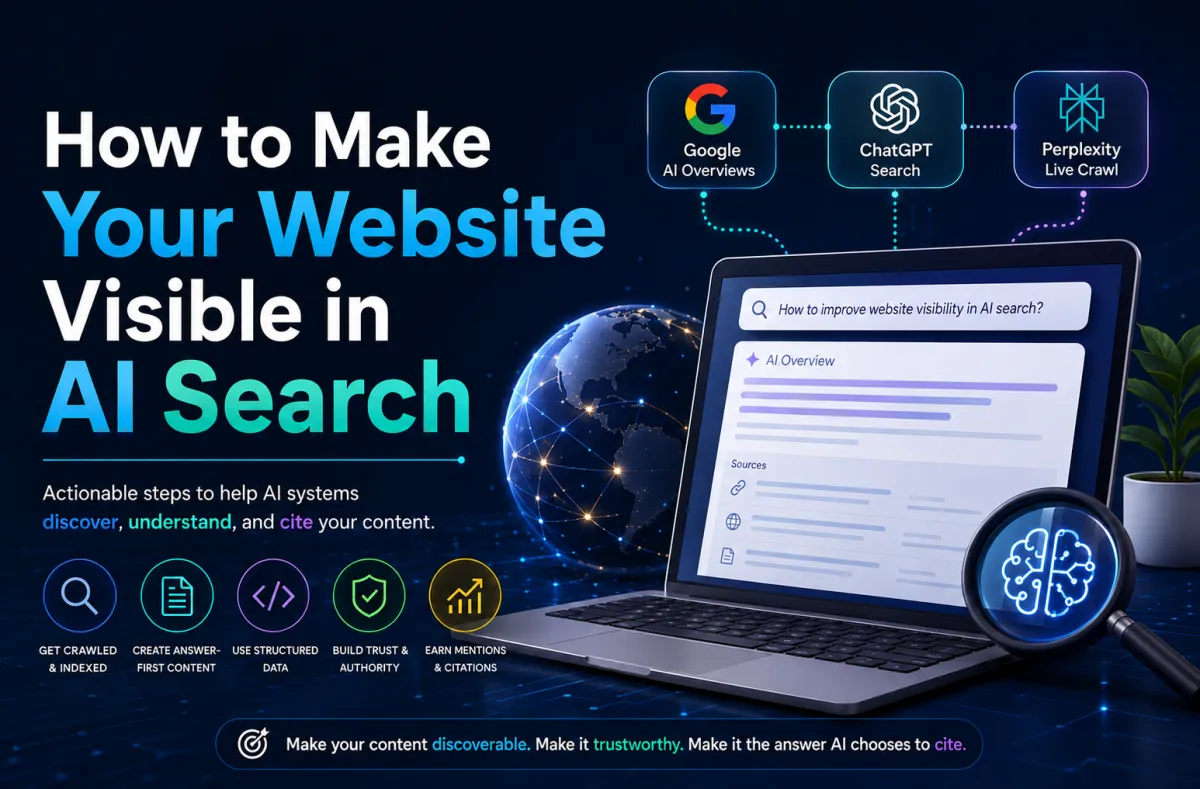
AI search visibility is quickly becoming the single most important growth lever for websites. Every month, more people skip the traditional list of blue links and instead ask Google's AI Overviews, ChatGPT, or Perplexity a direct question — and only sites with real AI search visibility ever make it into the answer. Whether you call this work AI search optimization, AI SEO, AI website optimization, or Generative Engine Optimization (GEO), the goal is the same: get your website found, correctly understood, and confidently quoted by the AI systems people now use instead of a search results page.
This guide covers how to make your website visible in AI search — access, content structure, and trust signals — with platform notes for ChatGPT SEO, Gemini SEO, Perplexity SEO, and Claude AI SEO, because ranking on Google alone does not guarantee brand visibility in AI everywhere else.
What Is AI Search Visibility?
AI search visibility describes whether your page actually shows up inside an AI-generated answer — as a cited source, a quoted passage, or a clickable link — rather than the AI answering from a competitor's site, or from its own training data with no attribution at all. It's a different measurement than a classic ranking: a page can hold the #1 spot in Google Search and still have zero AI visibility if AI Mode never pulls a passage from it.
Improving AI visibility means clearing two separate gates. First, the AI system's crawler has to be able to reach and read the page — an access problem. Second, once reachable, the model has to be able to lift a clean, self-contained answer out of it without distorting the meaning — an extraction problem. Solving only one of these rarely produces meaningful AI search ranking gains: a well-written page behind a blocked crawler is just as invisible as a fully crawlable page with vague, unquotable answers.
AI SEO vs. Traditional SEO: Understanding GEO, AEO, and Generative Engine Optimization
If you've seen AI SEO, AI search engine optimization, GEO SEO, answer engine optimization (AEO), and Generative Engine Optimization used interchangeably, that's because they largely describe the same discipline. Different communities favor different shorthand — some say "GEO," others "AEO" — but both point at the same goal: getting a website read, understood, and quoted by generative AI systems instead of ranked as a blue link.
Generative Engine Optimization for websites sits on top of traditional SEO rather than replacing it. Every AI platform still needs a page to be crawlable, indexed, and reasonably trustworthy in a normal search index before an AI model ever gets the chance to quote it. What changes is the content-level work: instead of writing primarily to satisfy a ranking algorithm, AI search optimization asks you to write primarily to be excerpted — clean, self-contained, quotable passages a model can lift out with confidence.
The Three AI Search Platforms You Actually Need to Rank In
Treating "AI search" as a single target is the most common strategic mistake. Google, ChatGPT, and Perplexity retrieve content differently, so a page can win on one platform and stay invisible on another.
Google AI Overviews and AI Mode (Gemini SEO)
Google's AI Overviews and AI Mode run on Gemini and pull directly from Google's regular Search index — Google has said AI Mode passed 1 billion monthly users by May 2026, and independent tracking found roughly a quarter of all searches now trigger an AI Overview, rising toward half in commercial categories. Gemini SEO isn't really a separate discipline: a page has to already be eligible to rank as a normal blue link before it can ever be pulled into an Overview — as Google itself explains, AI Overviews are built to give "a snapshot of key information about a topic or question with links so you can easily explore more on the web."
ChatGPT Search (ChatGPT SEO)
ChatGPT search retrieves mainly through Bing's index plus OpenAI's own OAI-SearchBot crawler, then has the model evaluate and select what to cite. This two-step process is why how to optimize website for ChatGPT needs a step Google SEO doesn't: a page absent from Bing Webmaster Tools is unlikely to reach ChatGPT's candidate pool, no matter how well it ranks on Google. Research published in 2026 found raw Bing ranking position is only a weak predictor of whether ChatGPT actually cites a page — indexing gets you into consideration, but a separate evaluation layer decides what gets quoted, which is ultimately how to rank in ChatGPT search over time.
Perplexity AI (Perplexity SEO)
Perplexity runs a live retrieval-and-rerank pipeline on nearly every query through its own PerplexityBot crawler rather than depending on a static index. Perplexity SEO rewards freshness more heavily than the other platforms, since genuinely updated content has a measurable edge from near real-time re-crawling, and Perplexity checks whether other independent sites corroborate a claim before citing it.
Claude AI SEO follows a similar access-first pattern: Anthropic's ClaudeBot and Claude-SearchBot need explicit robots.txt access before Claude's own search features can read and eventually cite a page.
Core Factors That Decide AI Search Ranking
Once access and extractability are solved, how to rank in AI search results comes down to a handful of factors that separate cited pages from ignored ones:
- Semantic completeness — answering the full question and its follow-ups, not just the headline keyword.
- E-E-A-T signals — a named author with real credentials.
- Entity clarity — an unambiguous business or author identity.
- Structured data accuracy — schema matching what's on the page.
- Freshness — genuine updates, not a changed byline date.
- Third-party corroboration — independent sources agreeing.
- Technical trust — fast, stable, mobile-usable pages.
A technically flawless page with a vague, unattributed claim still won't outrank a page that names its subject and sources plainly — AI search ranking rewards specificity over polish.
How to Make Your Website Visible in AI Search
Here is the practical order for how to make your website visible in AI search — access first, structure second, trust third.
Step 1: How to Optimize Website for AI Search — Fix Crawler Access
None of the content advice below matters if AI crawlers can't reach your pages, and this is the most commonly skipped step. Check robots.txt for OAI-SearchBot and ChatGPT-User, PerplexityBot, Google-Extended and standard Googlebot, and ClaudeBot and Claude-SearchBot. For platform-specific robots.txt examples, see our complete guide to making a website visible in ChatGPT, Gemini, and Perplexity. If any of these are disallowed — or silently blocked by a CDN, since some providers changed their default bot-blocking behavior — you're opting out of citation before content quality even enters the picture. Confirm the crawlers are actually visiting by checking server logs, not just by reading robots.txt.
Step 2: How to Rank Website in ChatGPT — Get Indexed on Bing
Because ChatGPT search draws heavily on Bing's index, a page that ranks well on Google but was never submitted to Bing Webmaster Tools may be effectively invisible to ChatGPT. This gap is the most common reason a site ranks well on Google and stays invisible in ChatGPT search. Submit a sitemap and use IndexNow, Bing's real-time submission protocol, to close that gap faster than waiting on an organic crawl. This also answers how to get your website found by ChatGPT and how to get website mentioned in ChatGPT: indexing is the floor requirement, and content quality decides what happens above it.
How to Appear in Google AI Overviews
Appearing in an AI Overview is an extension of ranking in regular Google Search, not a separate track. The page must be indexed and eligible to show a normal snippet, and it helps to confirm inclusion in Search Console's generative AI features reporting. Write the direct answer to the target query in the first 100–150 words as a self-contained sentence, since AI Overviews retrieve short passages rather than whole pages. Don't chase the #1 spot as the only goal — Google's AI retrieval regularly pulls from pages outside the top three based on passage quality alone.
How to Rank in Perplexity AI
Confirm PerplexityBot isn't blocked, then focus on freshness and corroboration rather than backlinks alone. Perplexity's rerank step rewards content that was substantively updated recently and content that other independent sites agree with. Because Perplexity crawls live on nearly every query, a page that was stale for months can start appearing again within days of a genuine content refresh.
How to Optimize Content for AI Search Engines
Once a page is crawlable, the deciding factor in how to optimize content for AI search engines is whether the model can pull a clean, self-contained answer out of it — the single highest-leverage content change across every platform.
Lead every section with a direct, quotable answer of roughly 40 to 90 words placed immediately beneath the heading, before any elaboration. Write it so it still makes sense if lifted out of the page entirely: name the actual subject instead of writing "it" or "this," and keep numbers, dates, and definitions in full sentences rather than split across dependent clauses.
Match structure to the question type. Step-by-step questions need numbered lists, not prose paragraphs. "Best," "vs.," or "which" questions need a comparison table with real trade-offs. Definition questions need one concise, standalone sentence before any expansion. Anything with multiple valid options needs bullets, so the model can parse discrete items instead of extracting one option out of a paragraph and losing the surrounding context.
Use FAQ, HowTo, and Article schema markup where the content genuinely matches what's on the page — it helps because it removes ambiguity, not because it manufactures authority.
How to Get Cited by AI Search Engines
Structure gets a page extracted; trust gets it selected in the first place, especially when several pages answer a question equally well. This is the core of how to get cited by AI search engines.
Third-party corroboration matters more here than it did in classic SEO — Perplexity explicitly weighs whether other independent domains say the same thing before citing a page, and citation patterns across OpenAI, Perplexity, and Google AI search tend to concentrate on a small number of established, frequently corroborated sources. Earned mentions on other credible sites now carry more weight than raw backlink counts did in an older era of SEO.
Freshness is a genuine ranking signal, not just good practice. Bing factors in last-modified date, which feeds what ChatGPT can retrieve, and Perplexity's live crawl rewards real updates — new data, a corrected claim, an added example — over a byline date changed with nothing else altered.
Author and source expertise still matters. State real credentials and first-hand experience plainly rather than hiding behind an unattributed "experts agree." Research from Princeton and Georgia Tech — the paper that coined the term GEO — found that adding citations, statistics, and quotations to a page increased its odds of being used in a generative answer by 30 to 40% compared with unoptimized content, while keywords stuffing produced no measurable improvement.
How to Optimize for ChatGPT and Gemini Together
Most sites don't need two separate playbooks for how to optimize for ChatGPT and Gemini. Since ChatGPT retrieves through Bing plus its own crawler while Gemini-powered AI Overviews retrieve through Google's own index, the technical step is identical either way: confirm both OAI-SearchBot and Googlebot have access, then get indexed in both Bing Webmaster Tools and Google Search Console. The content-level work — answer-first passages, real trust signals, genuine comprehensiveness — is the same for both, so build one strong page instead of maintaining platform-specific versions. For the full technical checklist, see our guide to making a website visible in ChatGPT, Gemini, and Perplexity.
AI Search Optimization Strategies for Websites: Quick Checklist
If you only have twenty minutes, work through these AI search optimization strategies for websites in order:
- Confirm OAI-SearchBot, PerplexityBot, Google-Extended, and ClaudeBot aren't blocked in robots.txt or your CDN.
- Get indexed in Bing Webmaster Tools, not just Google — the single biggest reason sites stay invisible in ChatGPT search.
- Rewrite your top three to five pages with answer-first passages: a direct answer in 40–90 words, then explanation.
- Add FAQ and Article schema wherever the content genuinely matches — it clarifies, it doesn't manufacture authority.
- Make your business name, services, and location consistent across your site and every external profile.
- Track a fixed set of real customer questions monthly across ChatGPT, Perplexity, and Google AI Overviews.
Access problems block everything downstream, so fix them first.
How to Improve AI Search Visibility: Measuring Results
Traditional rank tracking doesn't capture AI citations, so how to improve AI search visibility starts with a separate measurement habit. Track your AI Overview and AI Mode appearances for target queries — several SEO platforms now report this as "AI share of voice" alongside standard rankings. Ask the AI tools directly using the exact questions your content targets, and note whether your domain is cited and which passage got pulled. Watch server logs for OAI-SearchBot, PerplexityBot, Google-Extended, and ClaudeBot to confirm they're visiting on a normal schedule. One 2025 analysis found that while AI Overviews reduce overall click-through rate, pages that do get cited see noticeably higher click-through than non-cited competitors, since the reader arrives already primed by the summary.
Common Mistakes That Hurt AI Search Ranking
- Blocking search crawlers while trying to block training crawlers — disallowing anything with "GPT" or "AI" in robots.txt often blocks OAI-SearchBot along with GPTBot.
- Optimizing only for Google and assuming ChatGPT follows — Bing indexing is a separate, necessary step.
- Writing answers that only make sense in context, opening with "this also helps because..." instead of naming the subject.
- Treating llms.txt as a citation strategy — studies found no measurable link between having it and getting cited in AI answers.
- Publishing thin, keyword-matched pages instead of genuinely complete answers — comprehensiveness correlates with citation, not keyword density.
FAQ
How to get website mentioned in ChatGPT?
Get indexed in Bing Webmaster Tools first, confirm OAI-SearchBot isn't blocked, then write answer-first passages so the model can extract a clean quote once it evaluates your page.
How to make website visible in ChatGPT?
Combine Bing indexing with a robots.txt that explicitly allows OAI-SearchBot and ChatGPT-User, and update content often enough that Bing's last-modified signal stays fresh.
How to get website cited by ChatGPT?
Being indexed only gets a page into ChatGPT's candidate pool — citation depends on a separate evaluation step that favors extractable, well-corroborated answers.
How to increase website visibility in AI search?
Fix crawler access, restructure top pages with answer-first passages, and track real customer questions monthly across ChatGPT, Perplexity, and Google AI Overviews.
How to optimize website for generative AI search?
Treat it as three connected workstreams — access, extractability, and trust — since failing any one leaves a page invisible.
What is Generative Engine Optimization for websites?
Generative Engine Optimization for websites is the practice of making a site crawlable by AI search bots, structuring content so it can be extracted cleanly, and building the trust signals that get it selected over competing sources.
Conclusion
AI search visibility isn't a future consideration — it's already reshaping how people find businesses online. The sites that win aren't necessarily the ones with the most content; they're the ones that removed the handful of blockers keeping genuinely good pages from ever being read by these systems. Fix crawler access, write answer-first passages, and build real, verifiable trust signals, and the same page can start showing up across Google AI Overviews, ChatGPT search, and Perplexity — not because you gamed one algorithm, but because you made the content genuinely easy for a model to trust and quote.




Leave a Reply