

Getting cited in AI search means passing two separate tests: your page has to be retrievable by whichever index or crawler the AI system uses, and it has to be written so the AI can lift a clean, accurate passage out of it. Miss either one and it doesn't matter how good the content is — Google's AI Overviews, ChatGPT search, and Perplexity all skip pages they can't find or can't safely quote.
The tricky part is that "AI search" isn't one system. Google AI Overviews runs on Google's own index. ChatGPT search runs mostly on Bing's index plus OpenAI's own crawler. Perplexity crawls the web live, on every query. Optimizing for one doesn't automatically get you the others, which is why a site can rank well on Google and still be invisible in ChatGPT.
Whatever you call this work — AI search optimization, AI SEO, AI website optimization, or AI search engine optimization, or platform-specific shorthand like ChatGPT SEO, Gemini SEO, Perplexity SEO, or Claude AI SEO — the underlying task is the same: get found, get read correctly, and get quoted. Marketers also use GEO SEO and answer engine optimization (AEO) interchangeably with GEO; all three terms describe the same practical goal of building AI visibility and brand visibility in AI, not separate disciplines.
What "Visible in AI Search" Actually Means
AI search visibility means your page gets pulled into an AI-generated answer — as a cited source, a quoted passage, or a link a reader can click — rather than the AI answering from an unrelated site or from its own training data with no citation at all.
Three surfaces matter right now, and they're not interchangeable:
- AI Overviews and AI Mode — Google's AI-generated summaries, built on Google's regular search index and a version of Gemini. Google has said AI Mode passed 1 billion monthly users by May 2026, and Conductor's Q1 2026 analysis found roughly a quarter of all searches triggered an AI Overview, rising toward half in commercial categories.
- ChatGPT search — retrieves primarily through Bing's index and OpenAI's own OAI-SearchBot crawler, then has the model evaluate and cite from what comes back.
- Perplexity — runs a live web search on nearly every query through its own PerplexityBot crawler, re-ranks candidates, and shows its sources openly.
Generative Engine Optimization (GEO) is the umbrella term for optimizing toward all three. It doesn't replace SEO — it sits on top of it. Every platform still needs your page to be crawlable, indexed, and trustworthy before an AI model ever gets a chance to quote it.
What Generative Engine Optimization for Websites Actually Involves
In practice, Generative Engine Optimization for websites is three connected workstreams, not one task:
- Access — making sure the right crawlers (OAI-SearchBot, PerplexityBot, Googlebot, ClaudeBot) can actually reach and read your pages.
- Extractability — writing and structuring content so a model can lift a clean, accurate passage out of it without distorting the meaning.
- Trust — giving the model a reason to prefer your page over a competitor's when both answer the question equally well: real expertise, consistent entity information, and corroboration from other independent sources.
A site that's strong on one workstream and weak on another still won't get cited — a beautifully written page behind a blocked crawler is invisible, and a fully crawlable page full of vague, unattributed claims won't be trusted enough to quote. The rest of this guide is organized around fixing each of the three, roughly in the order they matter.
Core Factors That Decide How to Rank in AI Search Results
Once a page clears the access and extractability bar, a handful of factors consistently separate pages that get cited from pages that don't:
- Semantic completeness — whether a page answers the full question and its natural follow-ups, not just the headline keyword. Research analyzing over 15,000 AI Overview citations found pages scoring highly on this measure were several times more likely to be cited than thin pages covering only the surface query.
- E-E-A-T signals — experience, expertise, authoritativeness, and trust: a named author with real credentials, first-hand detail, and a track record on the topic.
- Entity clarity — an unambiguous business, author, or product identity that the model can resolve confidently (covered in more detail below).
- Structured data accuracy — schema that matches what's actually on the page, not aspirational or unused markup.
- Freshness — genuine content updates, not just a changed byline date, especially for platforms like Perplexity that crawl live.
- Third-party corroboration — other independent sources saying the same thing, which several platforms now weigh explicitly before citing a claim.
- Technical trust — fast, stable, mobile-usable pages that pass Google's page-experience checks, since a page that fails technically rarely gets far enough to be evaluated on content at all.
None of these work in isolation, and none substitutes for the others — a technically perfect page with a vague, unattributed claim still won't get cited over a page that names its subject and sources plainly.
Get Indexed and Crawlable First
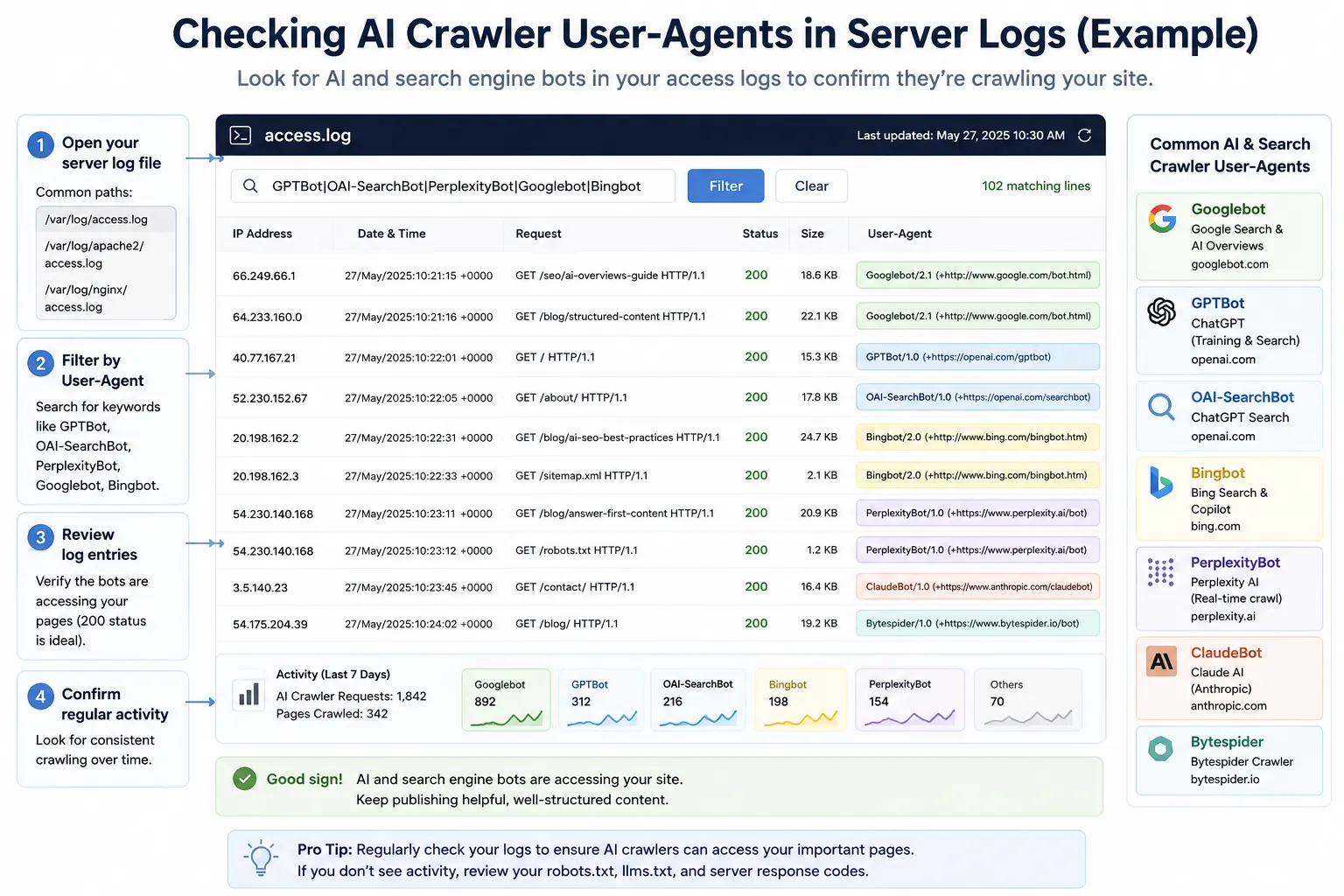
None of the content advice below matters if AI crawlers can't reach your pages. This is the most commonly skipped step, and it's usually a five-minute check.
Check your robots.txt against the right bot names
Search crawlers and training crawlers are increasingly separate, and you can allow one while blocking the other. The bots that matter for AI search citations — not training — are:
- OAI-SearchBot and ChatGPT-User (OpenAI's search and live-fetch crawlers — separate from GPTBot, which OpenAI uses for model training) For platform-specific robots.txt examples, see our guide to making a website visible in ChatGPT, Gemini, and Perplexity.
- PerplexityBot (Perplexity's crawler)
- Google-Extended and standard Googlebot (Google's AI features run on the regular Search index, so normal Googlebot access is what matters most)
- ClaudeBot and Claude-SearchBot (Anthropic)
If any of these are disallowed in robots.txt, or if a CDN is silently blocking them — Cloudflare changed its default bot-blocking behavior, which has caught a lot of site owners off guard — you're opting out of citation before content quality even enters the picture. Check your server logs for these user agents to confirm they're actually visiting, not just technically permitted.
Get indexed on Bing, not only Google
Because ChatGPT search draws heavily on Bing's index, a page that ranks well on Google but was never submitted to Bing Webmaster Tools may be effectively invisible to ChatGPT. Submitting a sitemap and using IndexNow — Bing's real-time submission protocol, not supported by Google — closes that gap faster than waiting for an organic Bing crawl.
Don't rely on llms.txt to do this for you
llms.txt is a proposed markdown file, placed at your site root, meant to hand AI systems a clean summary of your content. It got popular fast in 2025. The evidence in 2026 doesn't support it as a citation lever: Ahrefs' study of more than 137,000 domains found that AI crawlers almost never request the file, and SE Ranking's analysis of roughly 300,000 domains found no statistically significant relationship between having one and getting cited in AI answers. Google's Gary Illyes has said publicly that Google doesn't read it and has no plans to; John Mueller compared it to the old keywords meta tag. No major provider — OpenAI, Google, Anthropic, or Meta — has confirmed using it in production search.
That doesn't mean it's harmful to have one. It's genuinely useful for AI coding assistants like Cursor pulling your API docs. It's just not a search-visibility tactic, and treating it as one means the twenty minutes spent writing it were better spent fixing robots.txt or writing extractable answer passages — the things that actually correlate with citations.
Structure Content So AI Can Actually Extract It
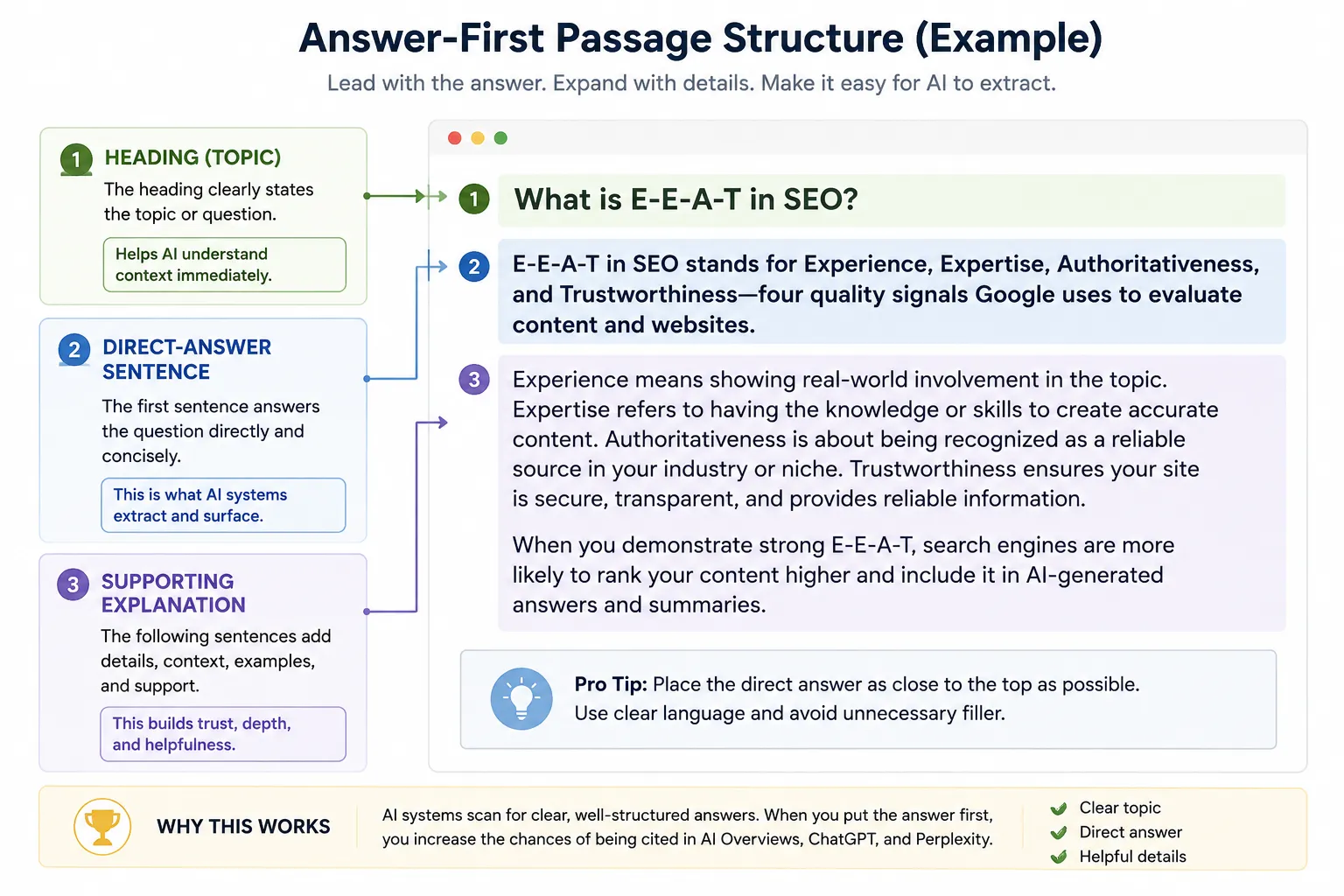
Once a page is crawlable, the deciding factor is whether the model can pull a clean, self-contained answer out of it. This is the single highest-leverage content change across all three platforms.
Lead every section with a direct, quotable answer
Put the answer to the question in the heading in one tight sentence or short paragraph — roughly 40 to 90 words — directly beneath that heading, before any elaboration. Write it so it would still make sense if lifted out of the page entirely: name the actual subject ("Google Search Console's report shows..." rather than "It shows..."), and keep numbers, dates, and definitions in full sentences instead of splitting them across clauses that depend on a previous sentence.
This single pattern — answer first, explanation after — is the one tactic that shows up consistently across independent research on all three platforms. Google's own documentation on AI Mode describes a "query fan-out" process, where a question gets broken into several sub-queries and the system retrieves passages matching each one; a page that answers only the headline keyword and skips the natural follow-up questions gets partial credit at best.
The difference is easy to see side by side:
| Weak passage (hard to extract) | Stronger passage (self-contained) |
|---|---|
| "It depends — get in touch to find out more." | "A basic five-page business website typically covers positioning, copy, responsive design, and launch support; cost rises with custom photography, booking systems, or CRM integration." |
| "We offer comprehensive AI search solutions." | "[Business name] helps service businesses get indexed by Bing, structure pages for AI Overviews, and track AI citations monthly." |
| "Our process is seamless." | "The process runs through audit, technical fixes, content restructuring, and a 30-day measurement window." |
The right column names the actual subject, states a real number or step where one exists, and doesn't depend on the sentence before it to make sense.
Match structure to the question type
- Step-by-step questions → numbered lists, not prose paragraphs describing steps.
- "Best," "vs.," or "which" questions → a comparison table with real trade-offs, not just feature lists.
- Definition questions → one concise, standalone sentence before any expansion.
- Anything with multiple valid options → bullets, so the model can parse discrete items instead of extracting one option out of a paragraph and dropping the context.
Use schema markup, but treat it as clarification, not decoration
Structured data (FAQ schema for genuine FAQ sections, HowTo schema for real sequential processes, Article schema for authorship and publish dates) gives AI systems an unambiguous, machine-readable version of what your page already says. Google has stated there's no special schema requirement unique to AI Overviews — it helps because it removes ambiguity, not because it's a secret trigger.
Recognize That Each Platform Retrieves Differently
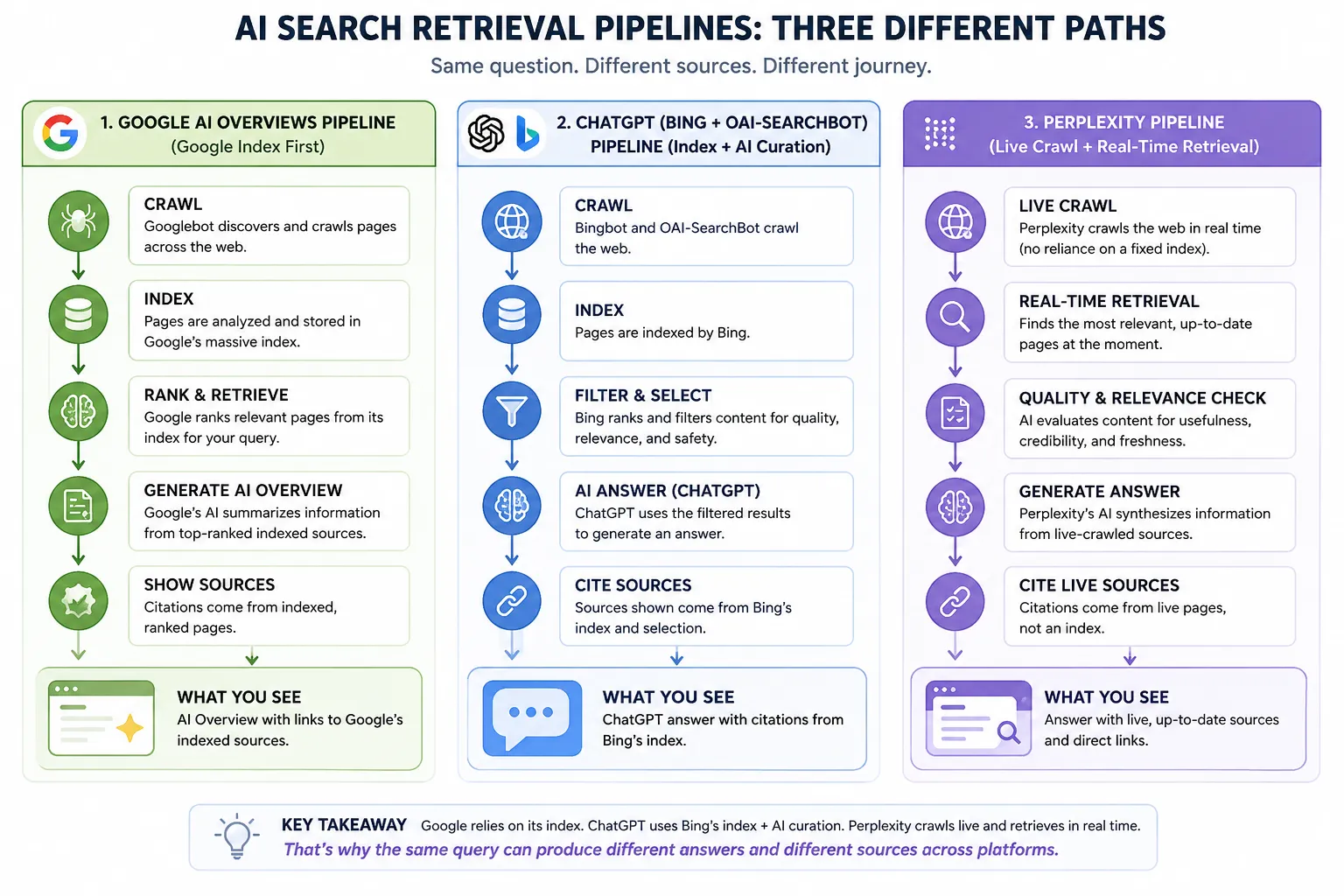
Treating "AI search" as one target is the most common strategic mistake. The retrieval mechanics genuinely diverge:
Google AI Overviews and AI Mode are grounded in Google's normal search index. A page has to be eligible to appear in standard Google Search — indexed, not blocked, meeting Google's helpful-content standards — before it can ever be pulled into an AI Overview. Google's guidance is explicit that this is an extension of core Search ranking, not a parallel system with separate rules.
ChatGPT search works differently. When a search is triggered, ChatGPT rewrites the user's question into several of its own search queries (a process similar to Google's fan-out) and runs them against Bing's index plus its own OAI-SearchBot crawl, then the model reads and evaluates the returned pages before deciding what to cite. Independent research published in 2026 found that a page's position in Bing's raw ranking is a weak predictor of whether ChatGPT actually cites it — being indexed in Bing gets a page into the candidate pool, but a separate evaluation layer decides what gets quoted. Practically: confirm indexing in Bing Webmaster Tools, and separately confirm in server logs that OAI-SearchBot is actually fetching the page — those are two different checks, not one.
Perplexity runs a live retrieval-and-rerank pipeline on nearly every query rather than depending on a single static index. It fetches current pages through PerplexityBot, filters candidates for topical match, then reranks the shortlist on freshness, structural clarity, and cross-source corroboration — meaning it often checks whether other independent sites say the same thing before citing a claim. Because it crawls near-real-time, recently updated content has a real, measurable edge here in a way it doesn't for Google's index, which refreshes on its own schedule.
The practical consequence: a Bing Webmaster Tools submission does very little for Perplexity, and a fast PerplexityBot response does nothing for AI Overviews. Treat these as three separate distribution channels that happen to reward similar content quality, not one target you can hit with a single checklist.
How to appear in Google AI Overviews
Getting into an AI Overview is an extension of ranking in regular Google Search, not a separate track:
- Meet Google's standard technical requirements — the page must be indexed and eligible to show a snippet in normal Search results. If it can't appear as a regular blue link, it can't appear in an Overview either.
- Confirm your site is included in Search Console's generative AI features (Google requires this separately from normal indexing eligibility).
- Write the direct answer to the query in the first 100–150 words, in a self-contained sentence, since AI Overviews retrieve short passages rather than whole pages.
- Don't chase rank #1 as the goal — Google's retrieval for AI Overviews regularly pulls from pages outside the top 3 based on passage quality, not just position.
How to rank in ChatGPT search and get cited by ChatGPT
Ranking here means clearing two separate gates, not one:
- Confirm OAI-SearchBot isn't blocked in robots.txt (it's distinct from GPTBot, which OpenAI uses for training).
- Get indexed in Bing Webmaster Tools — Bing indexation is the floor check; a page absent from Bing is unlikely to be retrieved at all, regardless of how well it ranks on Google.
- Once indexed, the model separately evaluates the page's content for citation. A page can be indexed in Bing and still not get cited if the answer isn't extractable — this is why answer-first structure (covered above) matters even after indexing is solved.
How to optimize a website for ChatGPT and Gemini together
Most sites don't need two separate strategies here. Since ChatGPT retrieves through Bing plus its own crawler while Gemini-powered AI Overviews and AI Mode retrieve through Google's own index, the technical step is the same either way: confirm both OAI-SearchBot and Googlebot have access, and get indexed in both Bing and Google. The content-level work — answer-first passages, real trust signals, genuine comprehensiveness — is identical for both, so build one strong page rather than platform-specific versions.
How to get cited by AI search engines in general
Across Google AI Overviews, ChatGPT, and Perplexity, three things consistently separate cited pages from ignored ones: crawler access isn't blocked, the answer is written as a self-contained passage near the top of its section, and the claim is corroborated by other independent sources rather than resting on the page's own say-so. Platform-specific steps — Bing indexing for ChatGPT, PerplexityBot access for Perplexity, Search Console's generative AI inclusion for Google — come after these fundamentals are in place, not instead of them.
Build the Trust Signals AI Systems Actually Check
Structure gets you extracted. Trust gets you selected in the first place, especially when several pages answer a question equally well.
Third-party corroboration matters more than it did for classic SEO. Perplexity's ranking explicitly weighs whether other independent domains say the same thing before citing a page, and one analysis of citation patterns across OpenAI, Perplexity, and Google AI search found citations concentrate heavily on a small number of established outlets. Earned mentions — being referenced by other credible sites, not just linked to — carry more weight in this system than they did in a pure backlink-count era of SEO.
Freshness is a real signal, not just a best practice. Bing uses last-modified date in its own ranking, which feeds into what ChatGPT can retrieve. Perplexity's live crawl rewards genuinely recent updates over stale republishing. A substantive content update — new data, a corrected claim, an added example — is worth more than editing a byline date without changing anything else; AI systems evaluating trust can generally tell the difference.
Author and source expertise still counts. If real credentials, direct experience, or original data support a claim, state them plainly and specifically — a named author with a stated role, or a described first-hand test — rather than an unattributed "experts agree." Never claim testing, results, or credentials that don't actually exist; an AI system cross-referencing sources is likely to flag unsupported claims as low-trust, and so is a human reader.
Citing your own sources helps. Independent research from Princeton and Georgia Tech (the paper that coined the term GEO) found that adding citations, statistics, and quotations to a page increased its likelihood of being used in generative answers by 30 to 40% compared with unoptimized content — and that keywords stuffing produced no such improvement.
Make the business or brand entity unambiguous
Before an AI system can trust a claim, it has to resolve who is making it. Remove ambiguity on-site:
- One consistent business or brand name, used the same way everywhere — homepage, About page, footer, social profiles.
- A plain-language statement of what the business actually does and who it serves, not just a tagline.
- Accurate, current contact and location details, matched across the site and any external profiles (directories, Google Business Profile, LinkedIn).
- An About page that explains real experience and credentials, not just a brand story.
Inconsistent naming or mismatched details across your own site and your external profiles is one of the quieter reasons a page with genuinely good content still doesn't get picked as a trusted source.
Measure Whether It's Working
Traditional rank tracking doesn't capture AI citations, so it needs a separate check:
- Track your own AI Overview and AI Mode appearances for target queries — several SEO platforms now report this as "AI share of voice" alongside standard rankings.
- Ask the AI tools directly, periodically, using the exact questions your content targets, and note whether your domain is cited, and which passage got pulled.
- Watch server logs for the crawler names above — OAI-SearchBot, PerplexityBot, Google-Extended, ClaudeBot — to confirm they're visiting on a normal schedule, not just technically permitted.
- Compare click quality, not just click volume, on pages that do get cited. Search Engine Land's 2025 analysis found that while AI Overviews reduce overall click-through rate on affected queries, pages that do get cited saw notably higher click-through than their non-cited competitors, because the reader arrives already primed by the summary.
Common Mistakes That Keep Sites Invisible in AI Search
- Blocking search crawlers while trying to block training crawlers. Disallowing everything with "GPT" or "AI" in the name in robots.txt often blocks OAI-SearchBot along with GPTBot, cutting off ChatGPT citations entirely.
- Optimizing only for Google and assuming ChatGPT follows. It largely doesn't; Bing indexing is a separate, necessary step.
- Writing answers that only make sense in context. A sentence that opens with "This also helps because..." can't be extracted cleanly — the model needs the subject stated, not implied by the previous sentence.
- Treating llms.txt as a substitute for indexing and structure. It's a nice-to-have for AI coding tools, not a citation strategy, per the 2026 evidence above.
- Publishing thin, keyword-matched pages instead of genuinely complete answers. Comprehensiveness — actually resolving the question and its obvious follow-ups — is what current research shows correlates with citation, not length or keyword density on their own.
- Never checking back. AI citation patterns shift within weeks as models and indexes update; a one-time audit goes stale fast.
AI Search Optimization Strategies for Websites: Quick Recap
If you only have twenty minutes, work through this list in order — the shortest practical path to real AI search ranking improvement across platforms:
- Confirm OAI-SearchBot, PerplexityBot, and Googlebot aren't blocked in robots.txt or your CDN.
- Get indexed in Bing Webmaster Tools, not just Google — the single biggest reason a site ranks well on Google but stays invisible in ChatGPT search.
- Rewrite your top three to five pages with answer-first passages: direct answer in 40–90 words, then explanation.
- Add FAQ and Article schema where the content genuinely matches — it clarifies, it doesn't manufacture authority.
- Make your business name, services, and location consistent across the site and external profiles.
- Track a fixed set of real customer questions monthly across ChatGPT, Perplexity, and Google AI Overviews to see what's actually working.
This is the practical shape of most Generative Engine Optimization for websites work in 2026: less about chasing every possible keyword variant, more about removing the handful of blockers that keep genuinely good pages from ever being read by these systems in the first place.
FAQ
Does having an llms.txt file help my website get cited by ChatGPT or Google?
No reliable evidence supports this as of 2026. Large-scale studies found no measurable link between having the file and being cited, and Google has confirmed it doesn't use it. Spend the effort on crawlability and answer-first content structure instead.
Does keywords stuffing help with AI search visibility?
No. Research specifically testing this found keyword density had no measurable effect on generative-engine citation rates, while adding real citations, statistics, and direct answers did.
How often should I update content for AI search visibility?
There's no fixed schedule, but substantive updates — new data, corrected claims, added examples — matter more than cosmetic date changes, and platforms that crawl live, like Perplexity, reward genuine recency more heavily than platforms relying on a periodically refreshed index.




Leave a Reply