

If you want to know how to make your website visible in AI search, there is no single submission button or special file that guarantees placement across ChatGPT, Gemini and Perplexity.
Each platform works differently.
ChatGPT Search uses OpenAI's search systems and OAI-SearchBot. Google's AI Overviews and AI Mode are built on Google's existing Search index and ranking systems. Perplexity operates its own search crawler, PerplexityBot.
The practical goal is to make your website technically accessible, publish genuinely useful information, give important pages clear internal links, and support factual claims with reliable sources.
Being crawlable does not guarantee a citation. But if the relevant systems cannot access or understand your pages, your chances of appearing are much lower.
Quick Answer: How Do You Improve AI Search Visibility?
To improve AI search visibility, focus on six fundamentals:
- Allow the crawlers relevant to each platform.
- Keep important pages publicly accessible.
- Make sure pages can be indexed where indexing is required.
- Publish original, useful and accurate information.
- Build a clear website structure with internal links.
- Measure actual citations, impressions and referral traffic.
| Platform | Main Technical Consideration |
|---|---|
| ChatGPT Search | OAI-SearchBot |
| Google AI Overviews & AI Mode | Google Search crawling and indexing |
| Gemini Apps | Google-Extended controls certain uses |
| Perplexity | PerplexityBot |
These are access mechanisms, not guaranteed ranking signals.
How AI Search Visibility Actually Works
Website visibility in AI-powered search can involve several separate stages:
Discovery: A crawler or search system finds the page.
Access: The system can retrieve the page successfully.
Understanding: The system processes the page and its information.
Retrieval: The page may be considered relevant for a particular question.
Surfacing or citation: A link or source may appear in an AI-generated response.
Do not treat these stages as interchangeable.
For example:
OAI-SearchBot successfully crawling your page does not guarantee that ChatGPT will cite it.
Likewise, being indexed by Google does not guarantee inclusion in an AI Overview
How to Make Your Website Visible in ChatGPT
OpenAI states that any public website can appear in ChatGPT Search.
For site content that you want discovered, surfaced and clearly cited, OpenAI recommends making sure OAI-SearchBot is not blocked.
See OpenAI's official publisher guidance for the current requirements.
A basic robots.txt rule can look like:
User-agent: OAI-SearchBot
Allow: /
OAI-SearchBot Is Not GPTBot
This distinction matters.
OAI-SearchBot is used for ChatGPT Search discovery.
GPTBot is a separate crawler that publishers can control when deciding whether content may be used for potential model training.
A website can therefore use different rules:
User-agent: OAI-SearchBot
Allow: /

User-agent: GPTBot
Disallow: /
This allows ChatGPT Search discovery while separately opting out of GPTBot access.
Check Your CDN and Firewall Too
A correct robots.txt file is not enough if your server blocks the crawler.
Your site may say:
User-agent: OAI-SearchBot
Allow: /
but still return:
403 Forbiddenbecause Cloudflare, another CDN, a firewall or bot-protection system blocks the request.
OpenAI also publishes SearchBot IP ranges for website administrators who need to verify legitimate crawler traffic. OpenAI explicitly notes that Search placement is not guaranteed even when a site is eligible.
How to Make Your Website Visible in Google AI Search and Gemini
Google requires a more careful distinction.
AI Overviews and AI Mode
Google says its generative Search experiences, including AI Overviews and AI Mode, are rooted in its existing Search ranking and quality systems.
They retrieve relevant information from Google's Search index.
That means the fundamentals still matter:
- Googlebot must be able to crawl the page.
- The page should be indexable.
- Important content should be accessible.
- Internal links should help Google discover pages.
- Content should be useful and relevant.
- Duplicate or unnecessary URLs should be minimized.
Google explicitly says that traditional SEO is still relevant for generative AI search.
Read Google's official generative AI search optimization guide for its current recommendations.
Gemini Apps and Google-Extended
Google-Extended is different from Googlebot.
Google describes Google-Extended as a robots.txt product token that lets publishers control whether content Google has crawled may be used for certain Gemini Apps and Vertex AI purposes, including model training and grounding.
Important:
Google-Extended does not control normal Google Search inclusion and is not a Google Search ranking signal.
So do not assume:
Blocking Google-Extended = blocked from Google SearchThat is incorrect.
For AI Overviews and AI Mode, normal Google Search crawlability and indexing remain the important foundation.
How to Make Your Website Visible in Perplexity
Perplexity uses a search crawler called:
PerplexityBotPerplexity says this crawler is designed to surface and link websites in its search results and is not used to crawl content for AI foundation models.
A basic robots.txt rule can look like:
User-agent: PerplexityBot
Allow: /
Perplexity also publishes IP ranges and recommends checking WAF or firewall settings when legitimate crawler traffic is being blocked.
See Perplexity's official crawler documentation for current crawler and IP information.
Perplexity also documents Perplexity-User, which can fetch pages in response to a specific user action. This is different from its normal search crawler.
Allowing PerplexityBot improves technical eligibility, but it still does not guarantee citation.
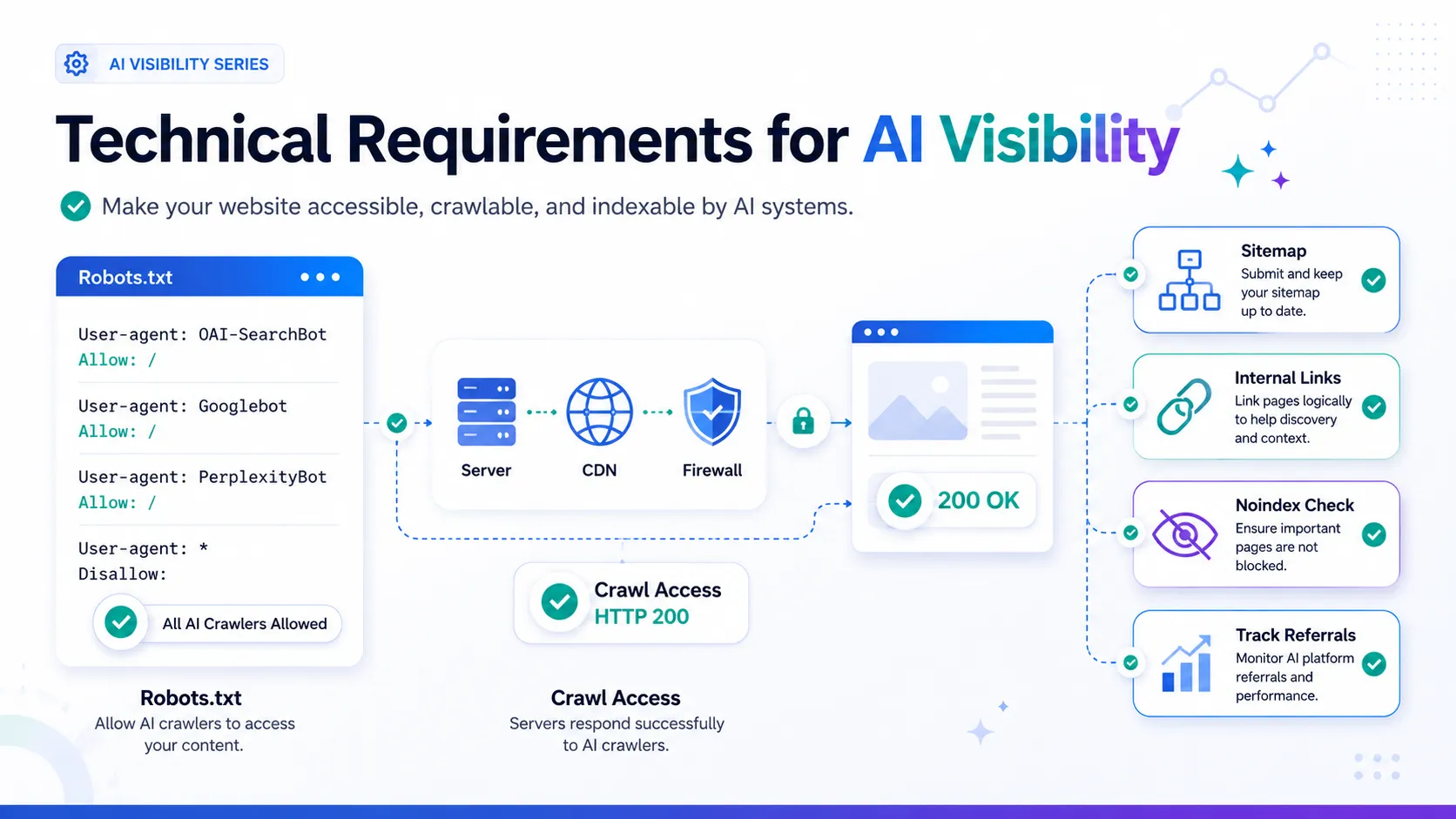
Technical Requirements for AI Search Visibility
Before rewriting content, confirm that important pages are technically accessible.
A public article should normally:
- return HTTP
200 OK; - be reachable without login;
- not require a CAPTCHA;
- avoid accidental
noindex; - use a stable URL;
- have contextual internal links;
- load its main content reliably.
Check robots.txt
Your robots file is normally available at:
https://example.com/robots.txtA rule such as:
User-agent: *
Disallow: /
can block compliant crawlers across the entire site.
Review the full file before copying crawler rules from another website.
Check noindex
Important public pages should not accidentally contain:
This can happen because of CMS settings, SEO plugins, staging configurations or template mistakes.
Keep One Main URL
Avoid publishing identical content across several URL variations.
Use one clear canonical version and make your internal links point to it consistently.
Publish Content That Adds Something New
Google's 2026 generative AI guidance specifically recommends creating non-commodity content—information that provides value beyond common knowledge.
This is particularly important for AI-related content.
A generic article that simply rewrites ten existing guides gives search systems little reason to prefer it.
Useful additions include:
- first-hand tests;
- original screenshots;
- server-log examples;
- real case studies;
- your own data;
- practical troubleshooting;
- expert commentary;
- verified comparisons.
For example, this is stronger:
Our server logs showed OAI-SearchBot receiving HTTP 403 even though robots.txt allowed it.
than:
Make sure AI crawlers can access your site.
Do not invent tests, numbers or case studies.
Answer the Question Directly
Do not write long introductions just to repeat the keyword.
Weak:
Artificial intelligence is transforming the rapidly evolving digital landscape and redefining modern online experiences.
Better:
To make a website visible in ChatGPT Search, first allow OAI-SearchBot and confirm that your server or CDN does not block legitimate OpenAI crawler requests.
The second version gives useful information immediately.
This approach also reduces unnecessary keywords stuffing.
Build a Logical Topic Cluster
AI search optimization should not mean publishing dozens of nearly identical articles.
A clean cluster could be:
AI Search Visibility Guide
        ↓
How to Get Indexed by ChatGPT
        ↓
LLMs.txt Guide
        ↓
AI Crawler Troubleshooting
Each page should answer a different search intent.
Internal links help crawlers discover related content and help users continue reading.
Do You Need LLMs.txt?
Do not treat llms.txt as a universal AI ranking requirement.
Google explicitly says that it does not use llms.txt for Google Search and that adding such a file neither helps nor harms Google Search visibility.
OpenAI's current publisher documentation focuses on OAI-SearchBot access rather than requiring an llms.txt file for ChatGPT Search.
Perplexity publishes an llms.txt file for its own documentation, but that does not prove that every website needs one to appear in Perplexity results.
Treat llms.txt as an emerging convention, not a replacement for:
- crawler access;
- indexing;
- internal links;
- useful content;
- reliable hosting.
Avoid Fake AI SEO Signals
Do not create fake mentions, fabricated expert quotes or low-quality backlinks just because someone claims AI systems need more brand mentions.
Google specifically warns against pursuing inauthentic mentions and scaled content created mainly to manipulate AI or Search results.
Focus on legitimate authority:
- real editorial mentions;
- genuine reviews;
- useful research;
- professional profiles;
- industry citations;
- accurate author information.
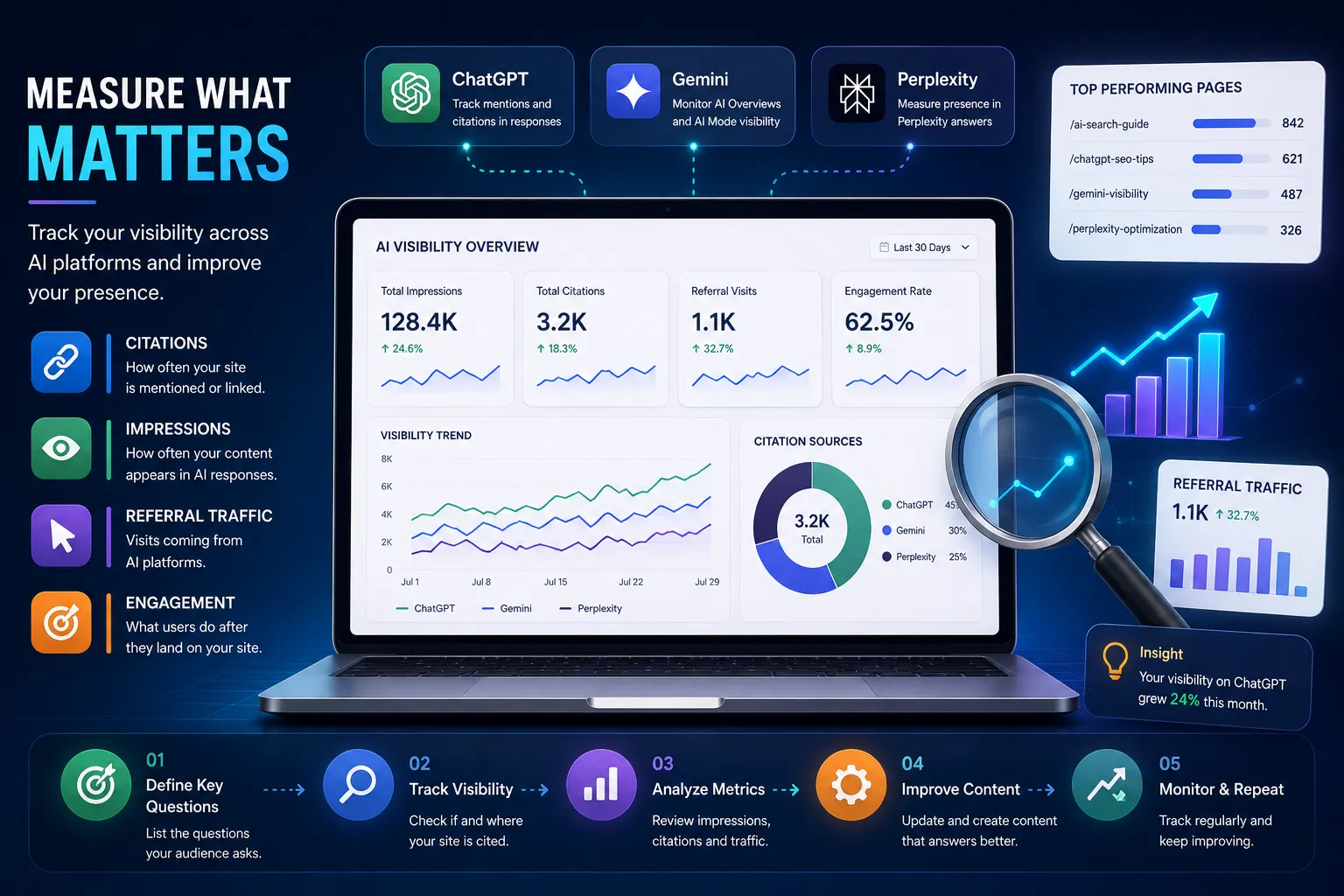
How to Measure AI Search Visibility
Do not judge visibility from one manual ChatGPT prompt.
Track a consistent set of questions over time.
Monitor whether your website is:
- mentioned;
- cited;
- linked;
- described accurately.
For Google, Search Console now provides dedicated generative AI performance reporting for eligible properties.
For ChatGPT, OpenAI says referral URLs automatically include:
utm_source=chatgpt.comThis makes ChatGPT referral traffic easier to identify in analytics.
Also monitor:
- landing pages;
- conversions;
- enquiries;
- signups;
- engagement.
Visibility is useful only if it supports your actual website goals.
Frequently Asked Questions
How do I make my website visible in AI search?
Make important pages publicly accessible, allow the relevant crawlers, maintain clean technical SEO, publish original useful information and build clear internal links.
How do I make my website visible in ChatGPT?
Allow OAI-SearchBot and confirm that your host, CDN or firewall does not block legitimate OpenAI SearchBot traffic. This makes the site eligible for discovery but does not guarantee placement.
How do I make my website visible in Gemini?
For AI Overviews and AI Mode, focus on normal Google Search crawling and indexing. Google-Extended separately controls certain Gemini and Vertex AI uses and does not affect Google Search ranking.
How do I appear in Perplexity?
Allow PerplexityBot and verify that your firewall permits legitimate crawler requests. Your content must still be relevant enough to be selected.
Does schema guarantee AI citations?
No. Structured data can still be useful for traditional SEO and rich-result eligibility, but Google specifically says no special structured data is required for generative AI search.
Does llms.txt improve AI rankings?
There is no universal official requirement showing that llms.txt automatically improves visibility across ChatGPT, Gemini, Google Search and Perplexity.
Final Takeaway
Learning how to make your website visible in AI search starts with separating technical access from actual selection.
For ChatGPT, make sure OAI-SearchBot can access the site.
For Google AI Overviews and AI Mode, maintain strong Google Search crawling, indexing and content quality.
For Perplexity, review PerplexityBot access.
Then focus on the content itself.
Create pages that:
- solve real user problems;
- provide original information;
- answer questions clearly;
- cite reliable sources;
- use logical internal links;
- stay accurate and current.
There is no guaranteed ChatGPT, Gemini or Perplexity ranking formula.
But a website that is crawlable, technically sound, original and genuinely useful gives these systems a much stronger foundation for discovering, retrieving and potentially citing its content.



Leave a Reply