

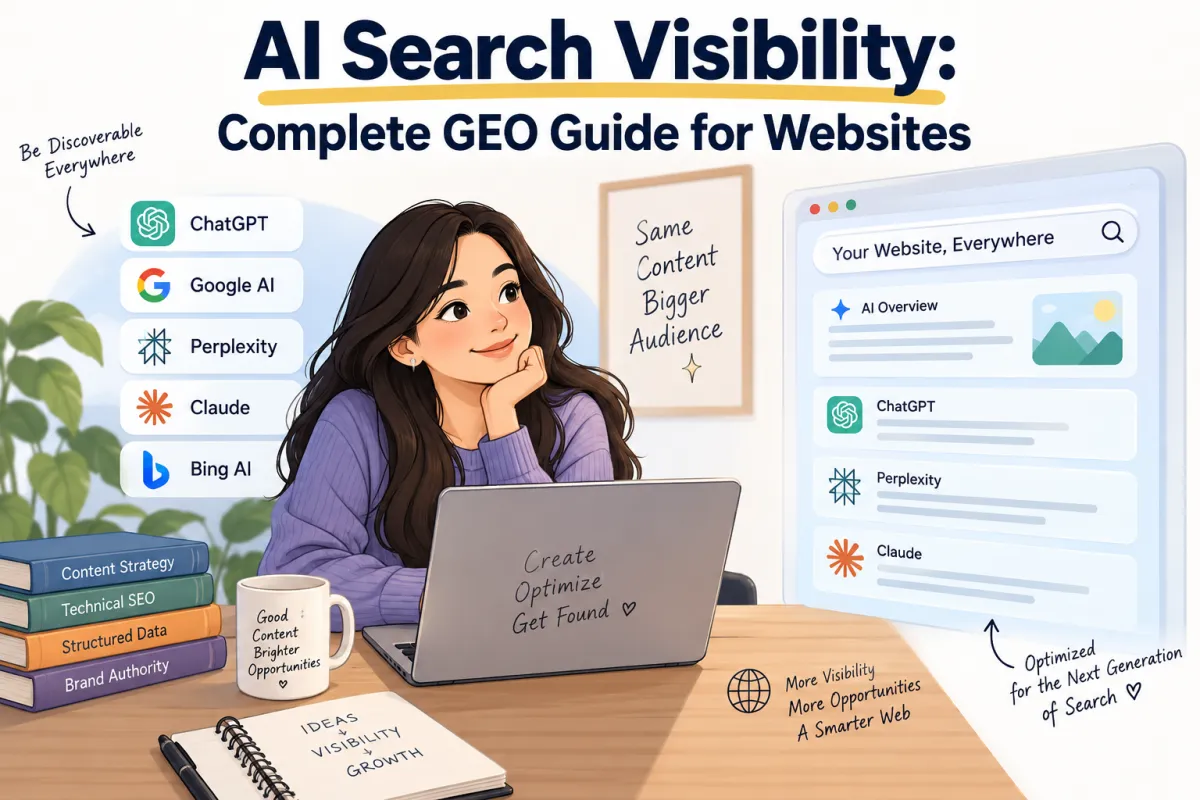
SEO optimizes content to rank in a list of search results. GEO — generative engine optimization — optimizes content to get cited, quoted, or summarized inside an AI-generated answer, whether that's a Google AI Overview, a ChatGPT response, or a Perplexity summary. They rely on much of the same groundwork: accurate content, technical crawlability, and clear signals of trust. What changes is the output you're optimizing for and how you measure whether it worked. Neither one has replaced the other, and treating them as competing disciplines usually leads to wasted effort in one direction or the other.
What GEO and SEO Actually Mean
What SEO Optimizes For
Search engine optimization is the practice of structuring a website and its content so that Google, Bing, and similar engines rank it higher for relevant queries. Its core levers are on-page keyword relevance, backlinks and site authority, technical performance (crawlability, page speed, mobile usability), and content that satisfies what the searcher was actually trying to find. Success shows up as a page position, an organic session, and a click.
What GEO Optimizes For
Generative engine optimization is the practice of structuring content so that a generative AI system can find it, trust it, and reuse it when constructing an answer. The term describes efforts to influence how large language models retrieve, summarize, and present information in response to a query, and it overlaps heavily with the related terms answer engine optimization (AEO) and AI optimization (AIO). Rather than winning a ranking position, GEO aims to become the sentence, statistic, or explanation the model pulls into its response — sometimes with a link back to the source, often without one. Wikipedia
Why This Distinction Became Urgent in 2026
The shift isn't hypothetical anymore. Ahrefs' latest research, based on 300,000 keywords, found that Google's AI Overviews now correlate with a 58% lower average click-through rate for the page ranking first, up from a 34.5% drop measured roughly eight months earlier. In practical terms, a page that used to convert a top ranking into steady traffic now keeps a much smaller share of the clicks it used to earn, even while holding the same position. cadillacnews
Gartner projected in 2024 that traditional search engine volume would fall 25% by 2026 as generative AI tools increasingly substitute for queries people used to run in a search engine. That's a forecast rather than a completed measurement, and it's worth treating it that way — multi-year predictions from any analyst firm don't always land exactly as stated. But directionally, it lines up with what the CTR data above already shows happening. gartner
Put together, these two data points explain why "just do SEO" no longer covers the whole job: rankings still matter, but a growing share of the answer a searcher sees never requires a click at all.
GEO vs SEO: The Practical Differences
| Dimension | SEO | GEO |
|---|---|---|
| Optimizes for | Ranking in the organic results list | Being cited or summarized inside an AI-generated answer |
| What "winning" looks like | A page in the top few positions that gets clicked | A brand or claim named inside a ChatGPT, Perplexity, or AI Overview response |
| Unit being evaluated | The web page and its position | The specific passage or fact the model extracts |
| Main signals | Backlinks, on-page relevance, technical health, site authority | Clarity, factual accuracy, and how well a passage stands on its own out of context |
| Primary metric | Organic traffic, rank position, CTR | Citation frequency, share of voice in AI answers, referral traffic from AI platforms |
| Content shape that performs | Long-form pages built around a keyword cluster | Self-contained definitions, direct answers, comparison tables, clearly labeled facts |
| Where you measure it | Google Search Console, rank trackers | AI-citation monitoring tools, manual prompt testing, referral-traffic segmentation |
What Google Says About GEO vs SEO
This is the part most GEO content skips, and it's the most useful thing to know before spending a budget on it. Google's own Search Central documentation states that from Google's perspective, optimizing for generative AI search is optimizing for the search experience — and is therefore still SEO. Google explicitly frames "AEO" and "GEO" as labels describing a narrower focus within SEO, not a separate discipline with its own rulebook. Google
That doesn't make GEO a meaningless label. It's a useful way to talk about a specific set of tactics — writing extractable sentences, structuring direct answers, building citation-worthy evidence — that matter more now than they did five years ago. But it means the starting point for GEO isn't a new playbook; it's the same fundamentals, applied with an AI reader in mind as well as a human one.
Where GEO and SEO Share the Same Foundation
A site with weak technical SEO won't perform well in either world. Both disciplines depend on:
- Crawlability and indexing. An AI system can't cite a page it can't access any more than Google can rank one.
- E-E-A-T signals. Demonstrated experience, expertise, authoritativeness, and trust affect both classic rankings and whether a model treats a source as reliable enough to quote.
- Structured data. FAQ, HowTo, and Article schema help traditional search engines understand a page's content, and they give generative systems an unambiguous way to parse the same structure.
- Content that actually answers the question. Neither Google's ranking systems nor a language model's retrieval step rewards a page that talks around a topic instead of answering it.
Nothing in this list is GEO-exclusive. It's the same groundwork SEO has asked for all along, now serving two audiences instead of one.
How to Optimize Content for AI Answer Engines
Write Self-Contained, Quotable Sentences
A model lifts a sentence out of its surrounding paragraph and drops it into an answer. If that sentence depends on the previous one to make sense ("It reduces this by roughly half"), it won't survive the trip. Name the actual subject: "Ahrefs' study found a 58% CTR drop," not "It found a 58% CTR drop."
Put the Direct Answer Before the Explanation
For every major question your content addresses, answer it in one clean sentence immediately under the heading, then explain. This is the same principle that wins featured snippets, and it's exactly what a generative system is trying to extract.
Use Structured Data Deliberately
FAQ schema on real follow-up questions, HowTo schema on genuine step-by-step processes, and Article schema with clear authorship all give an AI system a machine-readable map of your content. Add it because it clarifies structure, not because a checklist told you to.
Earn Citations With Original Evidence
Generic paraphrases of what ten other articles already say give a model no reason to prefer your page. A specific test result, a first-party data point, or a documented example is what makes a source worth naming.
Show Up Across More Than One Platform
Google, ChatGPT, Perplexity, and Gemini each source and weight content differently. Testing how your content performs in more than one of them will tell you far more than assuming success in one means success everywhere.
How to Measure GEO vs SEO Success
SEO has a mature measurement stack: rankings, organic sessions, and click-through rate, mostly through Google Search Console. GEO measurement is younger and less standardized — the closest equivalents are citation frequency (how often an AI platform names your brand or links your page in response to relevant prompts), share of voice against competitors inside those answers, and referral traffic segmented by AI platform rather than lumped into generic "organic" traffic. None of these has an agreed-upon industry benchmark yet, so track your own baseline over time rather than comparing to a number someone else published.
Common Mistakes When Approaching GEO vs SEO
- Treating GEO as a replacement for SEO instead of an extension that depends on the same technical foundation.
- Padding FAQ sections with keyword variations rather than genuinely answering a follow-up question a reader would ask next.
- Deprioritizing technical SEO on the assumption that "AI search works differently," when crawlability and site health affect both.
- Measuring GEO by rankings alone, when the actual signal — citation frequency inside AI answers — requires a different kind of tracking.
- Assuming one platform's behavior generalizes. A page cited heavily in Perplexity may never appear in a Google AI Overview, and vice versa.
FAQ
Is GEO replacing SEO?
No. Google's own guidance describes AI-search optimization as a continuation of SEO, not a separate discipline, and both depend on the same technical and trust foundations.
What's the difference between GEO and AEO?
In practice, very little — the terms are used interchangeably by most practitioners, with GEO usually referring to optimization for any generative AI system and AEO sometimes used more narrowly for direct-answer features. Neither term has a settled, universally agreed definition yet.
Do I need separate content for AI search versus Google?
Not separate content — better-structured content. The same page can rank in Google and get cited by an AI system if it's technically sound, answers the question directly, and is written in self-contained, factually precise sentences.
How do I measure whether GEO is working?
Track citation frequency by testing your target queries directly in ChatGPT, Perplexity, and Google's AI Overviews, and segment your referral traffic by AI platform rather than treating it as generic organic traffic.
Will adding schema markup guarantee AI citations?
No single tactic guarantees a citation. Structured data makes your content easier to parse, but the model still has to judge the content itself as accurate and worth citing.



Leave a Reply